


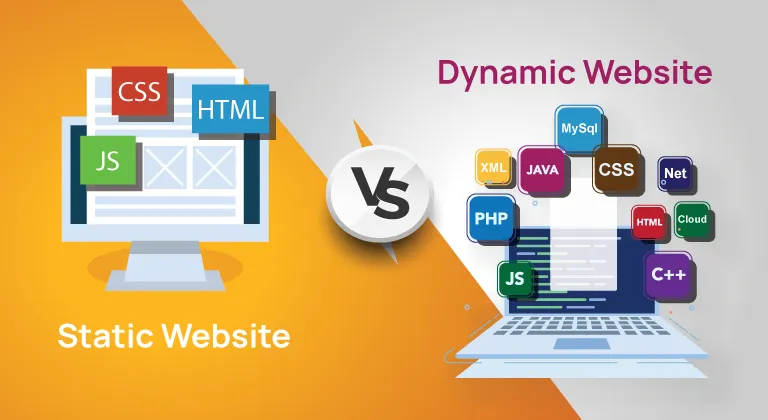
When you decide to build a website for your business, among static vs. dynamic websites, one of the first technical decisions that directly impacts performance, scalability, cost, and long term growth is choosing between a static and a dynamic website.
Most business owners focus on how their website looks. But what truly determines how your website performs, ranks on search engines, and supports your business operations behind the scenes is how it is built.
Static and dynamic websites function in completely different ways. Each comes with its own strengths, limitations, and ideal use cases. Understanding the difference can help you make a smarter investment that aligns with your business goals rather than just following trends.
Let us break it down in simple terms so you can decide what works best for your business.
A static website is built using fixed web pages that are pre coded with HTML, CSS, and sometimes basic JavaScript. Each page exists exactly as it is stored on the server and is delivered to the user’s browser without any real time processing or database interaction.
This means that every visitor sees the same content unless the developer manually updates the website files.
Static websites are usually used for:
Since there is no backend processing, static websites are known for being fast, secure, and lightweight.
Static websites load significantly faster because there is no need to fetch data from a database or generate content dynamically. The server simply sends pre built files directly to the user’s browser.
This improved speed enhances user experience and also contributes positively to search engine rankings. Faster websites tend to have lower bounce rates and higher engagement levels.
Because static websites do not rely on databases or server side scripting, they are less vulnerable to cyber threats such as SQL injections or server level attacks.
There are fewer moving parts involved, which means fewer potential entry points for hackers. This makes static websites a safer choice for businesses that want a low risk online presence.
Static websites do not require complex hosting environments. They can run efficiently on simple hosting servers which reduces operational costs over time.
For startups and small businesses with limited budgets, this can be an economical way to establish an online presence without compromising performance.
Since static websites do not have dynamic functionalities or database dependencies, they generally require less ongoing maintenance compared to dynamic websites.
This makes them easier to manage if your content does not change frequently.
Despite their benefits, static websites may not be suitable for businesses that need flexibility and real time content management.
Some limitations include:
If your business needs regular updates such as blog posts, product listings, or customer dashboards, a static website may become inefficient in the long run.
A dynamic website is built using server side technologies and connects to a database to generate content in real time.
Instead of displaying pre coded pages, dynamic websites fetch data from the backend and customize what users see based on interactions, preferences, or behaviors.
For example, when a user logs into an ecommerce store or fills out a form, the content they interact with is generated dynamically based on stored data.
Dynamic websites are commonly used for:
They allow businesses to provide personalized user experiences and manage content more efficiently through Content Management Systems.
Dynamic websites often come with a Content Management System that allows business owners to update website content without technical expertise.
You can edit text, upload images, publish blogs, and manage product listings through an intuitive dashboard.
This is especially useful for businesses that regularly update their offerings or publish new content.
Dynamic websites are built to grow alongside your business. As your operations expand, new features such as payment gateways, user portals, chat support, or analytics tools can be integrated easily.
This flexibility supports long term business growth without requiring a complete redesign.
Dynamic websites enable interactive features such as search functionality, personalized recommendations, and user specific dashboards.
These capabilities improve engagement and create a more tailored experience for visitors.
Businesses that rely on automation or customer data benefit from dynamic websites. Features such as booking systems, inventory management, and customer accounts can only be implemented through dynamic architecture.
Dynamic websites also come with certain challenges:
However, these issues can be minimized through professional development and performance optimization strategies.
Choosing between a static and dynamic website depends on your business model, goals, and operational needs.
A static website may be ideal if:
A dynamic website may be better if:
Your business requires regular content updates
You need ecommerce functionality
You want to offer personalized user experiences
Your website includes forms or login portals
You plan to scale your digital operations
For most modern businesses aiming to generate leads, manage customer interactions, or sell products online, a dynamic website provides the flexibility needed to support growth.
Your website is not just a digital brochure. It is a business tool that should align with your marketing strategy, customer engagement goals, and long term growth plans.
While static websites offer speed, simplicity, and security, dynamic websites provide flexibility, scalability, and functionality.
Understanding your business requirements will help you choose the right approach that supports both your current needs and future expansion.
If you are unsure which type of website suits your business best, working with an experienced web development team can help you make a strategic decision that maximizes your online investment.
You must be logged in to post a comment.
Our IT solutions work process begins with a comprehensive assessment